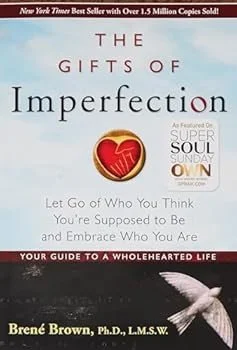
In her writings, workshops, TEDx talks, lectures, research projects, as well as her role as wife, mother, and friend, she develops what in many of us is both most vulnerable and most joyful, if one lets their guard down long enough to be themselves.
In this study and in personal accounts from others and from herself—she admits to being a “story-snatcher”—she tracks the patterns that comprise and are shared by people worldwide. Patterns include behaviors, thoughts, emotions, biases, judgments, fears, phobias, dreams and heartbreaks that comprise what gives a life meaning.
“Entrapment” is a word Brown often employs. She questions, for instance, how individuals find meaning and joy, purpose and passion in what they do both in and out of their employment or retirement. Underneath it all, she challenges the notion that if one cannot do something “perfectly,” one ought not do it at all. To live an imperfect life that encourages risk, failure, not being good enough, is preferable to waiting for the “perfect” moment to respond to challenges in life’s daily fabric.
On the other hand, those who live a compassionate life, bestowing this gift on self and others, is a way of setting boundaries: “I know it sounds strange, but I believe that understanding the connection between boundaries, accountability, acceptance, and compassion has made me a kinder person” (p. 16). She admits that before her own breakdown, she showed these qualities outwardly, but inwardly she was “judgmental, resentful, and angry” (p.16).
Quite frankly, by reading and taking notes (15 pages), I’ve concluded that perfection is grossly overrated in our culture. Just listen to its presence in ads, in interviews, in conversations. It has become an unconscious reflex, used more out of habit than either conviction or consciousness. Moreover, it is not even true.
Unfortunately today in our nation, “realities” are engineered or invented to occlude what is unpleasant, undesirable, imperfect, or unsavory. Making reality look perfect is a dishonest, immoral, unethical and scandalous tyranny on our citizenry and on our personhood.
Making reality sound so much more agreeable and freer of pollutants that counter the messy tatters of imperfection is both fear-based and undemocratic.
For some individuals, however, losing heart in the perfection industry may occasion a breakthrough in accepting their flawed and graceful creative self. Seeking perfection, Brown advises us, is a form of self-denial, if not self-shaming.
Her research as well as her personal narrative revealed that “when individuals write of the ubiquitous ghost of imperfection, then share it with others, they often comment on how healing it was “to go public” with shameful feelings of not good enough.
However, Brown notes that “Shame keeps worthiness away by convincing us that owning our stories will lead to people thinking less of us.
“Shame is all about fear” (p. 39). Resilience, she suggests later, is freeing, communal, and reality based. Being willing to change our patterns, those mythic structures that identify us, is a graceful gift to ourselves.
I also found helpful in “Guidepost #2: “Exploring our fears and changing our self-talk are two critical steps in overcoming perfectionism” (p. 58). An example of how each format sounds: Perfectionism self-talk: “Ugh. Nothing fits. I’m fat and ugly” and Healthy-striving self-talk: ‘I want this for me. I want to feel better and be healthier’” (p. 58). These two attitudes may contend for dominance in all of us.
To do the latter above requires what Brown labels “Practicing Critical Awareness” (p.67) which invites continual reality-checking the messages and expectations that drive the ‘never good enough’ gremlins. . .. It’s in our biology to trust what we see with our eyes. This makes living in a carefully edited, overproduced, and Photoshopped world very dangerous” (p. 67).
Today in unprecedented ways the news media bombards us with sets of realities that deny what we trust seeing see with our own eyes. The campaign is as vicious as it is ruthless. Brown’s use of the word “Photoshopped” is especially astute; the trend is worsening. If you have ever read George Orwell’s dystopian fiction, 1984, you know the brainwashing effects engineered to get each of us to surrender our vision of reality for one superimposed.
Her reflections on joy and suffering follow a few pages later: “Joy is as thorny and sharp as any of the dark emotions. . .. When we lose our tolerance for discomfort, we lose joy” (p. 73). Brilliant. I had not juxtaposed these two, seemingly contrary emotions until now. Brown borrows a rich metaphor from writer Elizabeth Kubler-Ross to underscore the former’s insight: “’People are like stained-glass windows. They sparkle and shine when the sun is out, but when the darkness sets in, their beauty is revealed only if there is a light from within’” (p. 74). Realizing this difference allows greater tolerance for suffering in darkness and perhaps assisting those with navigating their own underworld.
I admit to favorite Guideposts, especially #8: “Cultivating Calm and Stillness” (p.105ff). While Brown has read many texts on both states of being, I like the fact that she creates her own meanings: “I define calm as creating perspective and mindfulness while managing emotional reactivity” (p. 106). While the word calm is most often used as a noun, she shapes it into a verb. So, it is less that one is calm, more that one calms.
Many of us have learned to “count to ten,” before reacting, or taking a few deep breaths, and in these calm spaces, we regain consciousness. Her definition of stillness is equally creative: “Stillness is not about focusing on nothingness; it’s about creating a clearing. It’s opening an emotionally clutter-free space and allowing ourselves to feel and think and dream and question” (p. 108).
Both definitions can encourage us to describe our own definitions of these two terms which are central to Buddhist teachings whose purpose is to be present, be kind, be aware, and BE.
I end with Guidepost #9: Cultivating Meaningful Work (p. 111). It may be a full or part-time position, volunteering, as ways of getting one out of bed and the house regularly. The essential element here is that it has meaning for one’s life. For Brown this may mean sharing our gifts and talents, giving of ourselves to those who would benefit from our mentoring, and committing ourselves to this practice.
I also believe that such work is a form of prayer, an attitude of gratitude, a feeling of a fulfilling life, a tendency to go deep into what and who one is and is becoming. We are shaped or misshaped by the work we choose. Work that is without meaning is like a life without a myth; both form our destiny, both can stagnate us at a moment in our lives, and both can further a life of banality, especially when we focus on work exclusively to make money.
In Brown’s concluding insights, she believes that this book is not about self-help. I agree. Rather, it is more radical, for she senses that “it is an invitation to join a Wholehearted revolution. . Choosing authenticity and worthiness is an absolute act of resistance” (p. 125). Just note how true her words are in this period, January 2026; Revolution is the most effective way to save our democracy and ourselves. Failing here, what is left matters little.