There are often unpredictable moments when we feel out of alignment with who we are. It can breed uncomfortable feelings of “not feeling oneself.” A recent personal example will help.
My wife and I received a box in the mail containing hp print cartridges. They were the right ones for my computer model. But I had forgotten how to get to the cartridges to replace them, so I went online for help. I found a phone number and called a technician who works for HP.
With more patience than I would have mustered, he slowly walked us through the process, going so far as to email me a large diagram to follow while he stayed on the phone. We followed his instructions as well as the diagram on my computer screen. I discovered that I had not exerted enough force to lift the lid that exposed the cartridges.
From there we remembered how to prepare the cartridges and carefully removed the empty ones; we easily slid the new ones into their rightful slot. Then the test: to print a sheet that would confirm that all was aligned, and what I printed would be uniform on both sides. Without proper alignment the printer would not be even on the page. We printed one page of notes; all went well and the printer seemed happy with us for finding its way into alignment.
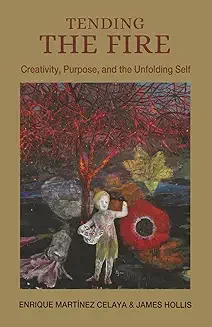
The next day a book I had ordered arrived in the mail. It was written by an artist, Enrique Martinez Celaya and a psychologist/mythologist I know well, James Hollis. They had collaborated over several years and recently published it: “Tending the Fire: Creativity, Purpose, and the Unfolding Life.” I dug right in.
In the first part of his essay, Celaya opens a rich discussion on alignment by asserting: “success is easily mistaken for truth, yet accomplishments frequently come at the expense of ourselves.” True enough. But sometimes someone recognizes something in us that we had not yet located as part of our path.
I remember when I was about 10 years of age that my father, not one to dispense gifts, brought home one evening a Scripto pen with 3 plastic translucent cartridges. Where did this gift come from? What did he see in me? I don’t know, but I remember feeling some deep alignment as I sat on the arm of a living room chair, loaded the pen and wrote out what I knew by heart: “Our Father,” “Hail Mary,” and “Glory Be” infinitely repeated from reciting the rosary.
When I was bored by what I had memorized, I began writing a short story wherein 2 of my brothers and I lived on a ranch somewhere close to California, busy tending the horses and having one adventure after another; most of the adventures included riding them. I was transported into a fictional world through the writing that connected me to a deeper part of myself.
Now at 81 and with dozens of books, articles, talks and op-eds published, I look back at that first moment that signaled the origin of my writing life. My sense is that many of you reading this could easily point to a turning point, a moment of alignment, when you felt at home on a deeper register than you had ever felt before.
Being in alignment, however, does not guarantee a life of achievement as defined by a culture that insists we be successful.
Hollis asks us to consider a few questions that promise to open us to the interior journey we engage, consciously or not: “why has this come to me?” “What is its summons?” “How am I trying to reframe my understanding of self and world as a result?”
Entertaining these deeper strata of one’s own narrative can direct us to others where one may find other values containing wisdom that is already within.