Entertainment as the New Reality

Originally published in the Herald-Zeitung of New Braunfels, Texas March 11-12, 2023

In the 18th. century the famous French author, Jean Jacques Rousseau, published his Confessions. His goal was a noble one: to give a full account of himself as a unique human being. His work may comprise a moment in history where our current blurring of fact and fiction began. He wrote that while he wished to stay with the facts of his life--but “if by chance I have used some immaterial embellishment it has been only to fill a void due to a defect of memory. . . . I have bared my secret soul. . ..”

When I read his autobiography, I found it impossible to tell where these “embellishments” appeared. His medium was the printed page. Since then, the delivery systems we turn to today are often social media outlets. Media guru Marshall McLuhan announced decades ago that media are not just channels of information. They also “shape the process of thought,” as Nicholas Carr reminds us in his 2011 study, The Shallows: What the Internet is Doing to Our Brains.

There is a further consequence that Carr tracks in his study: the “Net. . . is chipping away my capacity for concentration and contemplation.” Both activities, we know, require time, a slowness, to absorb the content through reflection. The electronic speed of our social media channels diminishes, if not annuls, these human faculties.

One of his colleagues, who writes about the use of computers, admitted to Carr that he had lost the ability “to read and absorb a longish article on the web or in print.” This atrophied capacity seems to be one of our most epidemic maladies today: the inability to even read most writing of any length, much less to reflect on its meaning. This withering of attentiveness may be a global virus, but it is gaining greater omnipresence in our culture.  

A recent Atlantic article in this month’s issue by Megan Garber, a staff writer, is titled “We’re Already in the Metaverse.” Her research is both astonishing and not a little unnerving. Garber’s byline gives summarizes of her argument. In the metaverse “Reality is blurred. Boredom is intolerable. And everything is entertainment."

Entertainment is not an evil. My wife and I gravitate to it regularly, watching documentaries, movies, or specials on cultural topics. But we don’t deploy it full time nor take up residency in this habitat of diversion. It is not a substitute for being in touch with a common reality and participate in its making. Garber points to the metaverse’s toxicity: “Dwell in this environment long enough, and it becomes difficult to process the facts of the world through anything except entertainment.”

How often do we see the declaration in what we view or read: “Based on a true story.” Fair enough. So what part is true, which fiction? Shades of Rousseau’s Confessions skips across centuries to signal an alert.  The blurred boundaries have led us to a world in which the fantasies of some event, the fictionalizing of it, now often replaces any allegiance to historical facticity. This replacement is compounded when we notice how often someone’s way of processing information  is stunted, shallow, nonreflective and scattered. Individuals may find themselves existing as regular residents of a fractured world.

When Garber offered several titles to watch that reflect this new fashioning of facts and history, my wife and I chose Gaslit. It is a fascinating and entertaining series on the Watergate break-in of the 1970s. But we continued to ask ourselves: How much of what we are viewing reflects the reality of that event, and what is engineered entertainment filler? We could not tell.

In a democracy, weakening the sense of a shared reality through entertainment’s portal can be dangerous and divisive for all of us.

Putting the Wisdom of the Psalms into Practice

Originally published in the San Antonio Express-News February 18, 2023.

Not long ago a close friend gifted me with a book: The One Year Book of Psalms: 365 Inspirational Readings. Her Christmas gift was well-timed; I began reading a Psalm and commentary on 1 January as part of my morning meditation. Over many decades making retreats at various monasteries in the United States, I loved rising early to chant them with the monks. It enhanced the Psalms’ poetic wisdom; chanting them always brought a sense of healing.

Each day I find the Psalm for that day a source of joy in both its intentions as well as the rich poetic images in its language. Most specifically, the Psalms for January 19 and 20 were 11 and 12. They helped me realize, to cite another book of the Bible, that there may in fact be nothing new under the sun. Perhaps under the moon’s white light as well. The Psalms are extraordinary in giving the reader a context for today’s turmoil, placing some of the disruptions into a larger historical and mythical container, to be contemplated from a new angle.

Psalm 11 introduces a renewal of Trust in God. “I trust in the Lord for protection” even as “the wicked are stringing their bows.” Their goal, continues the Psalm, is “to shoot from the shadows at those who do right.” Emotionally, we are pulled in several directions: “The foundations of law and order have collapsed/What can the righteous do?” Yet we are comforted by this epic observation: “The Lord still rules from heaven,” which pulls us poetically into a much larger vision, beyond the limits of all forms of media narratives that often would have us despair. We gain a new access in learning that “He hates everyone who loves violence” for God’s love is “righteous and he loves justice.” And then this revelation: “Those who do what is right will see his face.”

Poetry sees into the invisibles underpinning the visible world and offers by way of analogies furthers visions of wholeness. They are meant to be contemplated, not analyzed away. As poems, Psalms carry or transport knowledge to the heart; for millennia it was understood as the seat of knowledge. Poetry is heart-knowing. Reading the Psalms is another form of prayer from the heart.

Psalm 12 continues several of the same themes: “Help, O Lord, for the godly are fast disappearing. . .. Neighbors lie to each other/speaking with flattering lips and insincere hearts.” We can sense that each Psalm is a short story that first outlines a conflict or obstacle in the human heart, then reveals a saving intervention. Like any good story, a conflict is necessary to even have an engaging narrative.

Hope appears in a rich image that encourages our attention: The Lord’s promises are pure/like silver refined in a furnace/purified seven times over.” By a rich analogy we can see more, not less, of God’s power and purity. The Psalms are all rich in analogies that encourage the human imagination to see more of what is present, and to see more deeply into the souls that God addresses. And “even though the wicked strut about, /and evil is praised throughout the land,” faith allows the reader to know that God “will protect the oppressed.”

Like all wisdom poetry, including “Proverbs,” Psalms offer visions of wholeness and well-being that lie deep within conflicts; they can aid in adjusting our priorities to what is timeless and constructive; in so doing, one may commune with what is eternal in the human heart to moderate the dragons of despair and desperation. Such is the power of the human imagination in dialogue with itself and a larger landscape. The Psalms recognize the poet in each of us.

Happiness and Joy in Dialogue

Originally published in the Herald-Zeitung, February 11-12, 2023

A friend and I recently visited on zoom. Our conversation meandered into the topics of happiness and joy and whether they were two terms for the same feeling.

We noted that in our “Declaration of Independence,” there were certain unalienable rights including “Life, Liberty and the pursuit of Happiness.” We thought about what happiness means and what its pursuit entailed.

He pointed me to a documentary on Netflix entitled “Mission Joy: Finding Happiness in a Troubled World.” It contained excerpts from a weeklong discussion between his Holiness, the Dalai Lama and Archbishop Desmond Tutu on happiness, friendship and joy. It recorded conversations in 2015 of the Tibetan Buddhist monk who was exiled from his country after the Chinese government overran it and the Archbishop of South Africa who led the resistance against Apartheid in South Africa. His nickname is “Arch,” which he enjoys.

For both wise elders, suffering is a constant in their own lives. Both wished to explore what place joy has in a life of suffering. Joy and happiness, while sharing some similar qualities, are not synonyms. And both wondered aloud how joy can be cultivated in any life.

Joy, they discovered, came from a feeling of satisfaction with one’s life, when one feels that their life “has authentic meaning.”

Both men knew firsthand what living in squalor does to destroy a person or an entire people over time; both of their own people suffered this indignity for decades. Each man represented the voice of sustained suppression by powerful governments—Arch for being instrumental in bringing down the Apartheid Regime in Africa and the Dalai Lama for inspiring his people even as his country was being eviscerated.

Despair, despondency, and depression are formidable adversaries in any life, even within an entire people. A nation can become despondent. The Dalai Lama learned that suffering itself can be an appropriate testing ground for one who is. “Suffering can bring one to appreciate joy” the Dalai Lama affirmed. In the face of his own exile, he developed the art of curiosity that promoted well-being, which is a developed skill. It is critical to helping any person live a happier life.

His Buddhist training from early childhood on taught him “mentally to keep a calm mind. Take time each day for prayer, meditation and for quieting the mind.” He further encouraged in meditating to “begin with a death meditation. Remember that one’s life is impermanent.” Far from causing despondent thoughts, such a meditation can free one from the little orbit of their private lives and expand outward to others.

The Dalai Lama claims that “because the brain is very good, everyday keep learning, learning, being curious.” Neither man hides or diminishes the place of depression, despair and hopelessness as part of life, but both Arch and the Dalai Lama agree that cultivating “warm-heartedness” towards oneself and others can make a crucial difference.

If one’s cultivated attitude in life is to “give others comfort, it can offer others courage to go on.” Best not to make others feel guilty, they agree. Arch notes that “we are made for perfection” and our whole life is in that making.  

Part of one’s practice “in this delicate network,” Arch continues, engages us all in our shared humanity; “we are made to be compassionate.” Joy’s secret emerges when we can “touch our natural compassion—then live from there,” his friend adds.

Joy, Arch suggests, “is the reward of seeking to give joy to others” which rests on an authentic concern for others. Joy is also present in deep friendships; in fact, it is a basic quality of friendship.

The deep and lasting friendship between these two elders, elicits joy in us watching them tease, sport and joke with one another. They remain playful, heartfelt as they cultivate their friendship.

Being playful is another human form of being joyful. Perhaps less “pursuing happiness,” and more being joyful is closer to what can unite us in a universal friendship.

Haunting, Healing and an Open Heart

Originally published in the Herald-Zeitung January 14-15, 2023.

As the New Year begins to grow legs and venture forth into uncertainty, there is for many of us a patterned pull to engage some repair work to our lives that may repeat what we pledged to improve on from last year. It can take the form of a resolution, a renovation, or a fix-up.

The beginning of a new year has a mythic image expressed in the figure of the Roman god, Janus, after which the first month is named. He is the god of transitions, beginnings, and endings. Images that represent this two-faced god, one looking ahead, one looking back, are doorways, thresholds, passageways that lead from the past to the future. Janus is often shown holding a key that unlocks doors from one condition to another.

Perhaps the impulse we often feel is to look back at the previous year and reflect on what we achieved and what renovations are still pending; we look to the future at what we might improve as we redesign our lives to more accurately align with what we believe about ourselves, our identity, and our aspirations.

I am interested in the places that haunt us in the form of ghosts that we carry from our history into the future in a project of improvement that is essentially mythic and heart-directed. These ghosts may take the form of ideas, patterns of thought and behavior that create internal filibusters to stop our progress towards a more whole and coherent sense of who we are.

Our ghosts are show-stoppers, blocking growth and awareness; their origins are in our history with their own narratives that can be obstreperous and stubborn. I think of these ghosts as forces that steal the key from the god Janus, effectively blocking the way into the future because the door to the new year remains locked.

Perhaps our tendency to resolve something of the new year is a method we may use to deal with a faction of what has haunted us in the past. So resolutions might be understood as attempts to revise our history into a new form that is more acceptable to the image we imagine of ourselves.

On a personal level, my own haunting ghosts include:

  • Are you good enough to accomplish X?

  • What are your willing to risk in order to step out of well-worn patterns of thought and behavior—and is the risk worth it?

  • What changes in attitude towards yourself and others are worth sacrificing familiar habits that you have used for decades as protectors of your fragile narrative?

Friends have related their own ghosts that included the specter of remorse for not choosing a different life, one they yearned for but lacked the courage to pursue. Another asked: How much of my painful past—the ghost of intolerance--can I tolerate remembering without being completely overwhelmed and check-mated?

But perhaps there is another way to view this dilemma, one in which our ghosts are not dispelled or exiled but accepted as part of the fragile fabric of our identity. A Buddhist psychologist, Pema Chodron, suggests that far from exiling our ghosts, we develop a friendly and curious attitude towards them in a spirit of cease-fire with these haunting energies.

Far from resisting the haunts from our history, she suggests instead: “Give yourself a break. Get to know this stuff. Drop the story line; forget it.” The term “maitri” expresses an attitude of loving-kindness towards ourselves and the ghosts that haunt us. Then arises the possibility of extending this same heart knowing towards others.

Our hauntings can awaken the heart, not suffocate it or incite a heart attack over our ghosts. In this perspective, what haunts us can fill us with greater awareness of who/what I am that needs acceptance.

Democracy and Human Dignity

Originally published in the San Antonio Express-News, January 6, 2023.

A single word can spawn a host of thoughts, images and associations. As 2023 moves forward, the word dignity demands our attention. 

For the last half dozen years we have suffered the rhetorical slings and harpoons of indignity from a faction of our nation’s restless landscape. Many of us feel exhausted by the indignity of the Big Lie and the fantasy of widespread voting irregularities, nestled in the politics of grievance. Hardly a viable political policy; and a poor substitute for the goodwill needed to create better living conditions for the majority of American citizens.

Anger, arrogance, grievance, expressions of indignity over fantasized wrongs, victimhood, howlings for revenge— these are pale stand-ins for the constructive largesse of a functioning democracy. 

Recently I read a chapter from a series of lectures given by Wole Soyinka, recipient in 1986 of the Nobel Prize in Literature. Soyinka, born in Abeokuta, Nigeria in 1934, has been an activist for social justice his entire life.

In one of his projects to help a group of rebels in the Nigerian Civil War (1967), Soyinka “spent most of the next twenty-seven months in solitary confinement in a cell that measured only four by eight feet.” More than 30 years later, I met him at the University of Southern California where one of his plays was being performed. When my former student introduced me, I immediately felt the elegance and kindness of this poet-statesman.

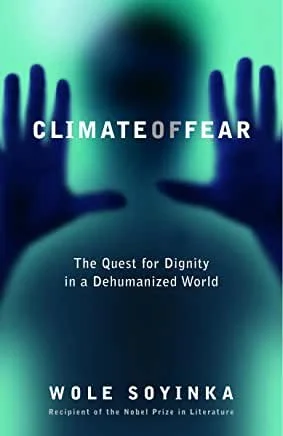
In 2004, he delivered five lectures titled “Climate of Fear” to the Royal institution in London. That same year, they were published in a book, “Climate of Fear: The Quest for Dignity in a Dehumanized World.” 

Soyinka’s thinking made me realize democracy is neither a thing nor an abstraction. Rather, it is an occasion, an event, a moment in history for human dignity to be expressed and encouraged as a fundamental universal quality of being human. 

One of its most crucial representations of this human quality is made public in everyone who qualifies for the right to vote. Beneath this right, which is also a rite, or a ritual, however imperfectly expressed, is the recognition of “equal membership in the human community, along with a confirmation of every member’s self-worth,” Soyinka writes.

Such an idea is buttressed by the encouragement and maturation of what Soyinka calls “self-consciousness,” which is inspired by allowing each member to become part of “interacting rings of community or association.” Its most crucial foundation is imparting to each member a sense of belonging, of being part of a magnificent whole to which each contributes a part.

In contrast to a politics of indignity, where indignance is a new form of entertainment for those who gravitate toward its stoked emotions, exists an attitude of thoughtfulness expressed in an allegiance to the shared reality upon which democracy rests.

Soyinka advises that “Dignity is simply another face of freedom,” thus the obverse of power and domination through grieving solicitudes. Litanies of anger, fury, outrage, feigned humiliation all conspire against the moral grain of dignity. When humiliation is extended to the population, it can harden into hate and its primal expression, violence. 

Despite its flaws and failings, democracy can still be the best strategy available to restore or deepen the dignity of the individual over the indignant voices that stoke victimhood and self-serving agendas. Democracy touches and encourages those mysterious treasures in the human heart: dignity and self-worth.

What Story Will We Choose to Remember?

Originally published in the Herald-Zeitung December 9, 2022.

The second anniversary of the January 6th. Insurrection is not far off.

I have thought about what story or stories will surface to express the reality of that day and those leading up to its execution. As in the past, there will be competing narratives, each advancing the events and their meaning to conform with outcomes that may be self-serving.

For several reasons I was drawn to an article in the December issue of The Atlantic entitled “How Germany Remembers the Holocaust and What America can Learn About Atonement,” written by Clint Smith.

As a mythologist I am interested in stories as carriers of values, aspirations, and ideals as well as the shadow side of both personal and collective myths. I also share with many an interest in what motivates some versions of stories to be cultivated and shared and which rise up through the energies of specific interests—political, spiritual, practical, fictional—and by whom?

Stories are vehicles that have as their core a belief or set of beliefs which we choose to adopt or reject in our personal or national life. Their power resides in their ability to shape our thinking as well as behaviors that emanate from them.  Stories are like the infrastructure that supports and maintains our identity. Who we allow, tolerate, or assign authority to in telling our story is a monumental decision because it shapes our destiny as a people. Today we find ourselves in the tall grass of competing narratives.

We might pay close attention to what kinds of stories are being suppressed today, what is allowed to be taught, what books should be banned, what ideas should be exiled, what values should be marginalized. For stories, more than any other form of expression, are the oldest carriers of our identity of who we are committed to.

These narratives grow directly from how we choose to remember our history and what we lean towards surgically removing, including our founding narrative as a Democracy, our shared origin myth.

Unfortunately, there are those in power positions who are making decisions with wide consequences. We must be cautious and vigilant about those who step forward to proclaim:

The following book titles should be banned from libraries and schools.

Topics on sexuality, race and gender should be prohibited to “protect our children.” For some age groups this is a good decision.

Certain truths about our own history of genocide would best be kept under wraps, their identity simply denied.

Real respectful conversations about our differences should be avoided, deploying instead a series of “d” words: deny, deflect, deceive, deflate, demean, destroy.

Such a “method” for silencing alternative views puts in direct jeopardy the most fragile, and seventh “d” word: Democracy.

Much has been written about America’s pseudo-innocence, which in its expression has taken up a less-than-nuanced stance towards history, especially our own. Pseudo-innocence prefers to keep the same historical accounts, the stories we wish to remember, frozen, atrophied so that our nation’s shadows remain hidden in the basement of our consciousness.

Remembering seems unwise. Yet it seems that remembering has its own propriety, its own moral or amoral code feeding it. So how we refuse to remember is worthy of our study, and along with it, what fiction we drive into the hard ground of history, will further form, or deform our fragile yet coherent myth.

Clint Smith’s illuminating article reveals how Germany today continues to create new rituals to remember the Holocaust; he notes that the movement to remember anew emerged not from government authorities who have their own myth to promote, but  “from ordinary people outside the government who pushed the country to be honest about its past.” He also delineates places in our country that have begun such efforts of honest reclamation of our story through memorials.

His final words will be mine: “It is the very act of attempting to remember that becomes the most powerful memorial of all.”

What Draws Us To Wonder?

Originally Published in the Herald-Zeitung, November 19,2022

Who has not occasionally paused to wonder about something or someone, some circumstance, some situation, that gathers mystery around it? For over 30 years I have written in my journal most mornings. As a prompt, I write about what wishes to be remembered from yesterday. It takes only a few seconds, after I have brewed coffee, lit a candle in my study at 4:30 a.m. and sit with that question, that the remembered events line up.

At the end of each morning’s writing, I ask myself: “What did you wonder about or become curious about yesterday?” Sometimes no answer steps up; other mornings two or three emerge, competing for attention.

I sense that wonder has its own way of knowing. A deeper form of learning is often evoked through wonder. Not seeking the right answer but paying attention to the questions that grow naturally from wondering, like the fruit that emerges from a well-tended seed that blossoms into a plant. That is wonder’s pathway.

Curiosity is also a form of wondering. So can questioning what we believe, value, and even what we sense might be time to discard in our lives. In one of his Dialogues, the Greek philosopher Socrates questioned his student on what he thought was the nature of knowledge. When his student grows dizzy trying to answer this question because it sets him wondering, his teacher saluted him: “this sense of wonder is the mark of the philosopher,” namely, the love of wisdom (Philo-Sophia). I sense that it grows directly from being curious.

Mythologist Joseph Campbell suggested that one of the primary functions of myth is to stir in the individual a sense of awe and mystery. I don’t think we have to travel any farther than what is valued in an ordinary day to find illustrations of either; but there is no such thing as ordinary, especially when events in our lives encourage or provoke wonder.

Wonder gains traction when it emanates from the heart, not the head. One experiences something or someone that is heart-felt. Wonder does not seek the right answer, the fixed fact; it is more nuanced than that, more pliable, more oblique.

In wondering we run the risk of touching what is mysterious in life, what gravitates toward a sense of awe. It brushes against what is both ineffable and sacred. In the words of Rabbi Abraham Joshua Heschel, “what we cannot comprehend by analysis we become aware of in awe.”

As an example: In these blessedly cooler mornings, my wife and I step out early, before daylight, and gaze for a few moments at the stars that appear so brilliantly against a black sky. There, in the stillness of 4:30 a.m., we stand for a moment in silence.

Gazing up at the night sky full of brilliant lights, we are inevitably drawn to wonder what this new day will bring, how it will both shape itself and be shaped in part by our plans, our schedules and our obligations. Wonder then seems to dissolve under the weight of duty.

In this early moment, however, we sense the power of wonder implicit in the ordinary. Wonder coaxes what we call “ordinary”—a word so inadequate to our experience, so we remain for another moment, silent in the immensity of the early morning sky before it dissolves into the day’s birthing sunrise.

In the cool dark air of the morning, we don’t stop to think; we stop thinking. For wonder seems more intimate with a felt sense of what is real and mysterious. In wonder we are allowed to exist in that narrow hyphen between them.

I sense that such fleeting moments are what poets and artists seek through their creative imaginations: to capture the beauty exposed by wonder and how, for instance, the moon’s shadows will spread across another day, shaping itself, already, from darkness into light.  

I end by wondering if these moments of closeness with the natural world serve as bridges to the ineffable mystery of the sacred’s presence, suddenly there in front of us if we open ourselves to its terms, not ours.         

Trout Fishing is Not About the Fish

Co-authored by Dennis Patrick Slattery and Roger Barnes
Originally published in the San Antonio Express-News on October 26, 2022

Many men go fishing all of their lives without knowing
that it is not fish they are after.
—Henry David Thoreau

We have been fishing for rainbow trout in the Missouri Ozarks for 30 years. It is an annual pilgrimage from San Antonio to a rural fishing lodge in southwest Missouri, 1600 miles round trip. We recently returned from our pilgrimage with reflections to share.

Over these three decades our friendship has strengthened on each excursion to the point that we now admit the week together is not about fly rods, reels, dry flies and nymphs. Nor is it about the fish we hook.

So, if the trip is not primarily about the mechanics of fishing, then what is the through line of this adventure?  We now realize that fishing has become a rich metaphor for what matters in our lives.

It is about camaraderie and friendship, undertaken in one of the most ancient of human activities, the journey, and what we discover each time we enter this vessel of adventure.  

In our younger days we fished early in the morning, then again late in the afternoon for hours on end. No longer. Our time on the stream has shortened considerably.  

Our pilgrimage has assumed a more contemplative, less active rhythm where the fish play a smaller role than they once did.  Emphasis has shifted comfortably from the fish and the size of the catches to our shared friendship.  

Catching three fish per day, not eight, is more than satisfying. Something more valuable is caught now in the nets of our imaginations, like a return to the value of an ordinary day and the treasures which invite a sustained feeling of gratitude.

Preparing and enjoying our meals together in the house we rent has become a sacred ritual.

Now, it is about sitting on the porch and feeling dusk descend. We enjoy hearing the crickets and other critters that stir in the thickening shadows, creating a chorus of sounds as the day curls into its own darkness.     

Our time of stepping out of the regular rhythms of our lives allows for remembrances and giving story form to memories of previous trips and to our lives more broadly.

Now in our 70s, we fish for stories to pull from the deep waters of memory. The stories allow their shiny, colorful hues, like those of the trout jumping into sunlight, to illuminate our present identity.

We have become more conscious of the reality that where the water runs most swiftly, and especially in the shadows of the stream, is where the invisible trout are clustered.  

It has become our way of reconnecting to the natural order, with its own wondrous rhythms and shadings.

Our fishing excursions bring much of our individual lives to the surface. Our life events are for a moment fixed in the telling, which is itself one of the richest elements in a long and sustained friendship.

Our fly lines have, over time, morphed into our story lines. We read more now on our outings and fish less.  It has become a shift in awareness where we now sense there are bigger fish to fry.

It is a time for rich conversations about what we have read or films we’ve watched. We are now, at our age, casting our attention at the meaning of life itself. These trips are the occasions for taking stock of the bigger questions that life poses.  

A shift in our collective attitude is itself a migration from quantity to quality, an important observation to consider because it includes the very journey of life itself in its constant flow, eddies and currents that attend our lives.

What we now grasp is the importance of connecting our stories.  They are the mythic underpinnings of our lives, offering us coherence, cohesion and camaraderie.

But, to be clear about the trout we do catch: yes, we take them home and we eat ‘em!

Meditation Has Lasting Benefits

Originally published in the Opinion page of the Herald-Zeitung, September 6, 2022.

A renewed interest in meditation practices is growing in our country. It is being used to increase consciousness, to improve health and vitality, to deepen one’s spiritual life and to offer a counter way of being conscious of our everyday experiences. It is also being evoked by more individuals pausing in their lives to ask: What kind of world is being shaped and insisting we accept its terms, values, assumptions and prejudices, as well as its beliefs, all of which can indoctrinate us into a world view that we may not be aligned with?

If we fail to pay attention to these often-subtle changes and shifts, we can become victims of the illusion of freedom. Pausing less to analyze, which is often ego-driven, one sided and reductionistic, and more to meditate, which draws us closer to our most authentic selves and to the implicit holiness of the ordinary, can improve our understanding. It coaxes us beyond information to a deeper transformation of who we are and are becoming.  

To cultivate a practice of meditating opens us to experience the daily round of our lives in greater depth. Each day we are asked by a variety of sources—news outlets, shows, movies, advertising, podcasts and political maneuverings, to remember and accept certain circumstances and conditions, and to forget others. We can then fall asleep in this din of forces to what is truly remarkable. I have discovered that meditating can cultivate a different attitude as well as a fuller way of imagining the world’s ordinary particulars as tinged with the sacred qualities of life.

In contrast to egoic, one-sided thinking, in which power is accumulated under the guise of analysis, meditation is more wholistic; it does not explain, it illuminates understanding. Meditation leans toward recognizing the interrelatedness of all parts of what at first glance seems so diverse, even antithetical to one another. Meditation allows, even welcomes, paradox, contradiction, as part of the fabric of life; it is closer to the image of weaving, of creating a tapestry rather than reinforcing the independence of life’s complexity with no underlying unity.

One of meditation’s most important qualities is that it can lead us to wonder, that is, to envision the ordinary happenings of each day—a brief contact with a stranger, an act of courtesy, a moment of self-forgiveness or forgiving another, the sounds that gather around one during a morning walk—as instances that evoke gratefulness for what might have seemed trivial before.

Meditating slows us down, even for the space of 20 minutes if one chooses to find a time each day for silence and solitude. Even taking a moment to become aware of our breathing, and to notice how often each day we move breathlessly from one task to another increases our conscious awareness.

Meditating awakens us to the beauty of our heart and to our sense of being embodied. It reveals how we might take in the world we inhabit at a single moment, with all of our senses and to feel joy in the process.

Meditating can also reveal where our lives are unlived or possibly needing renewal and revision. We may imagine how our inner life is disconnected from the outer social world we traverse daily.

It can also assist us during times of illness, misfortune, loss and grief by finding a place for such suffering within the larger fabric of who we are and to what we are destined.

A meditative practice can shift us from skating across the surface of posessions, distractions and future plans and promotions by reminding us of what we all paossess in common: this very moment of vulnerability and promise. We can be present only to the present. That itself is a gift worth acknowledging in meditations of gratitude.

Journey into Space and the Mythic Imagination

Originally published in the Opinion page of The San Antonio Express-News, September 3, 2022.

Human beings possess a deep hunger to explore, to leave the familiar known world and reach out to mystery, to what is uncertain and to gain new insights that deepen our understanding of who we are as a species. Myths have revealed this  for millennia.

With NASA’s announcement of a new series of 8 exploits called Artemis, the mythic dimension is once again front-and-center. The moon will serve as both destination and way station in the Artemis project, whose goal is to eventually reach Mars named after another Greek divinity, one of strife, but also of ambition, excitement and drive.

The Apollo program is no more. Next in line is Apollo’s divine sister, Artemis, who is associated with the moon and its illumination, as well as with nature and especially animals. Her favorite was the bear. As a huntress she possessed, like her brother, deadly accuracy with her arrows, especially as they travelled long distances to their intended mark.

Mythologist Joseph Campbell reminded us that myths use the language of metaphor for their energy and durability. Based on two words—meta=across or beyond—and phorein=to carry--a metaphor, like a myth, is “a transport vehicle” that encourages us to move out of the boundaries of the known and familiar into unknown worlds. By introducing Artemis, a goddess, NASA adopted a new metaphor, a new mythic figure, for such a transport.

This is a healthy sign both mythically and imaginally; it complements the earlier masculine presence of Apollo to establish a greater presence of feminine energy in space travel.

I sense in the “Artemis” naming for the next eight space flights—which includes the goals of sending a woman and a woman of color to walk on the moon’s surface—a mythic expression of integration with the masculine in the service of a greater wholeness and completeness. Her name is no small matter for our national imagination. A new analogy ripens with her presence, for both Apollo and Artemis are known in the wisdom tradition of myth for their healing powers. They are curative forces that promote healing wounds of infection, strife, dissension and disorder.

Mythic thinking has a strong poetic element,  and NASA rises in our imagination as a witness to this presence. Mythic—or mythopoetic thinking—rests on the power of analogy in creating a new story by reviving an old narrative and fabricating it in modern clothing. The space program is once again the launch pad for the imagination; it allows us to see ourselves withing a larger cosmic frame.

The power of myth is then twofold: First, to see ourselves anew within the frame of epic and vast terrain; the space program yields to something far greater and grander than us, yet includes our greatness as a species. Second, to see and imagine from a double perspective by retrieving from ancient history, as filmmakers Stephen Spielberg and George Lucas have done, stories and figures of earlier wisdom traditions, and reinstating them within our cosmic dreams.

The ancient past, then, coalesces with our dreams of a distant future. Such is the power of mythic imagination. We all need the mythic world to refresh us as we gaze skyward at the future. Let Artemis show us the way as our new guide, joining  the constellation of earlier figures on our trajectory deeper into the universe and into our knowledge of ourselves.

Theft of a National Narrative Harms Us All

Originally published in the Opinion page of the Herald-Zeitung, July 23-24, 2022.

There is an Irish saying my friend, Phil Cousineau included in his book, The Oldest Story in the World: any journey one takes is not complete until one tells a story about their adventure. So, the story about the voyage is as crucial to its meaning as the adventure itself.  In mythologist Joseph Campbell’s classic work of 1949, The Hero with a Thousand Faces, he illustrates three “moments” of a journey: 1. Departure from the normal and familiar; 2. Meeting with both adversaries as well as helping companions; 3. A return home with “the boon” or the story of what one has learned during their quest.

The boon or story surveys the knowledge and perhaps the wisdom that expands and deepens the storyteller’s vision of themselves and the world traversed. When shared with others, the story may deepen the level of their self-and-world knowledge; stories look both within one and outside to the world they inhabit. Many of you know that Twelve Step Recovery Programs are guided in large measure by stories, personal narratives told to and received by others. Some healing power emerges in narratives that one can experience imaginally, not necessarily literally.

We can connect with strangers and friends more deeply when we share our tales with them, which is to share our identity, our history, with others. Telling our narratives and listening to others’ plots satisfies a deep hunger in both speaker and listener. Our stories voiced is one of our most creative acts; sharing our stories can be a generous way of relating deeply to ourselves and with others on a level far more profound than those offered by statistics, surveys and other forms of facts that don’t reveal the contours of a coherent narrative on a deeper level.

When someone asks who we are, our response often takes the form of a story. Each story we tell or hear carries a mythic resonance. We remember that the word “mythos” means story.

When we identity deeply with our own story, we tap into closely-held beliefs, prejudices, shadows, values, assumptions and aspirations. In a sense, we language ourselves into our present being through the stories we tell. Narrating ourselves in the world seems to be essential to our nature as a species. This deep hunger reveals the impulse to present ourselves both as a story and in a story.

Storyteller Richard Kearney observes in his book, On Stories, that “each nation discovers it is at heart an ‘imaginal community,’ a narrative construction to be reoriented and reconstructed repeatedly.” Forgetting one’s narrative origins, he goes on, is dangerous, because it can lead to “self-oblivion” when the disease of a community takes itself for granted or becomes so narcissistic it believes it is the center of the world and therefore entitled to assert itself, to the detriment of others

In this light, Democracy is less a noun, more a verb; it is a story in motion. However imperfectly, an origin myth or story, embodies shared values and stabilizing meanings that promote the following in the collective imagination: 1. participation, 2. integration and 3. aspiration.  It shapes our past into formed memories that guide us as a people.

I am therefore more concerned with the theft today of our origin story, our founding narrative, that largely defines who we are and wish to become as a people sharing a communal narrative that aspires to benefit all its citizens.

Such a theft--to be replaced by a groundless fiction that is self-serving and just next door to wishful thinking—is felonious. If we allow our founding narrative to be eclipsed by a story-as-scam, we lose something essential to our identity as a people. Such corrosion unmoors us from a shared history and more painfully, perhaps, from one another.      

Betting on Fantasy: A Modern Allegory

Originally published in the Opinion page of the Herald-Zeitung July 9-10, 2022.

Not long ago I bought five lottery tickets for a total of five dollars. When I realized that the date was 6/22/22, my fantasy thinking kicked in and I made the investment. I believed the date had special significance conducive to my ability to win. So long as I didn’t run the lottery numbers through the machine at a local Pit Stop, I could maintain my belief that I might have won. Thus far I have side-stepped the “reality machine” waiting to read my ticket.

My desire to win, as well as my belief that I might have won, teamed up to allow me to sustain the myth of being a winner. So long as I don’t expose my numbers to the “reality” machine that will reveal whether I am a winner or a loser, I am able to sustain the fantasy of having won.

However, when I finally do run my ticket through the “reality check” and it reveals those dreaded words, “Not a Winner,” I have the option of rebuffing the machine’s fact by accusing it of malfunctioning and that I did in fact win. The accusation allows me to sustain my magical thinking.

I can further accuse and so deflect the fact that I lost, by accusing the store employees of rigging the machine so they can profit off my “winning ticket that my own fantasy thinking has manufactured. I can then override what has been called by D. Stephenson Bond, “directed thinking” (Living Myth), which is rooted in facts, in what can be proven, in order to maintain my magical belief.

An important shift in interpreting experience enters here. “I bet I won” subtly shifts into “I believe I won,” so now my magical belief is the new subject matter, not the fact that I lost.

When we live in a myth, writes Bond, we encounter experiences through culturally formed ways. If enough people can be persuaded to replace the “myth of fact” with the “myth of fiction,” then an empirical reality we once shared is dismantled under the mythic pressure of a new belief system—an alternative universe—a galaxy far away from the grounded reality that once prevailed that proven facts provide. They hold us together, like a bonding agent, so that while there is space for differences, there is an infrastructure that we collectively believe in and share.

What Bond calls “a functional adaptation to our cultural environment,” is ruptured, becomes dysfunctional and our connection to a shared empirical world “is thwarted.” No one escapes the infection of this maladaptation. Myths die when their balancing tendencies are disturbed, deflected and dismantled. Then dissociation may soon lead to fear, anger and violent disruptions in some of its participants.  

Myths, both personal and collective, are formed in just this way. This new myth can keep the “winner/loser” dis-oriented and disassociated from the truth of directed thinking. Perhaps, I think, I can persuade others that I have won so they too purchase my winner fantasy with their own “buy-in” belief that I did really win.

For the time being, I will continue to carry my lottery ticket in my possession. Each morning I wake a winner in my mind’s eye. I also suspect that all our beliefs ultimately return to the originary myth fanning life into them, be they rooted in reality or in fantasy. Someday soon, however, I need to face the “reality machine” at Pit Stop to close out my fantasy. Or collect my winnings!

Service Above Self

Building Community: Answering Kennedy’s Call by Harlan Russell Green.

Published in the Herald-Zeitung, June 29, 2022.

Writing a memoir can be tricky. It poses several complex questions: What do I include? What do I leave out? What do I lean on most to best capture the sense of my identity-in-formation? Am I remembering accurately? Harlan’s engaging biography of his life-long call to service finds a fine balance to the questions above. It also reveals through particular instances that transformed his life, the call of a soul to a context and to a contract with himself and with something larger than himself; it propels his myth forward as well as recollects it in hindsight.

Close in age to Harlan, I related to his call to serve after he graduated from Berkeley and joined the fledgling Peace Corps. His decision took him to a remote village in Turkey, Ismet Pasha. These life-changing years were followed by working for the Environmental Protection Agency; he also found himself assisting with and filming the plights of farm workers that Cesar Chavez helped to organize for safer and more equitable working conditions.

As a film maker, he found creative ways to migrate the suffering of marginalized people and communities into national consciousness. One of his most recent ventures was to spearhead efforts to raise the city of Goleta to the status of a city, but only after working on and organizing many groups with the capacity to tackle multiple deficiencies in its boundaries before it could be considered sustainable. Everyone of Harlan’s callings reveals the workings of his own soul-scape that were reflected in his efforts to improve livability standards, a soul-work-in-depth. One of the many mantras Harlan has lived by is “finding ways” as a central path he spiraled back to repeatedly. When he hit a dead-end, he found a way.

His memoir follows the deep grooves of so many written before his. Memoirs are mythic utterances wherein the author retraces their living vision revealed in the many particulars of a recollected plot. What surfaces is the creative genius of the person in accord with life’s circumstances that often appear as mysteries on the path of submission. These events appear to the memoirist as hungers or yearnings of the soul to be satisfied in living by a code of meaning and purpose; for Harlan it was centrally to make the lives of others more livable by transforming their daily circumstances into places of safety and equity—in short, social justice.

In such a template, a memoir like Harlan’s is a form of recreation. By that I mean a form of re-creation, wherein his creative muses nudged him from one series of life’s opportunities to another; he would eventually return home to work on Santa Barbara’s nearby relative, the city of Goleta, where my wife and I lived for 12 years and where we saw so many of these improvements Harlan organized and brought to fruition in that developing city.

What he tracks so admirably in his series of recollections is the interior changes in himself as he organizes positive and humane changes in the lives of others. At times, he will insert one of his poems to give aesthetic voice to a dramatic moment on his journey. As I read it, I realized once again that our interior lives are often expressed in what we do in the external world that mirrors one’s interior landscape. I can hear him asking, along with “What is a Livable City?” another question: “What is a Livable Life?” His memoir italicizes that there is no real space, no gap, between these questions and their responses.

I found his writing eloquent, impassioned, poetic and revelatory as he unfolded his own myth that was churning below the plotline of his achievements. For me, the greatest triumph is the quality of life so well-lived, guided by the perennial motto: “Service Above Self.” Harlan gets it: the path to the Self is in fact the same path to Serving Others.

Attempted Scam is a Lesson on Fraud

Originally Published in the Opinion Page of the Herald-Zeitung, May 21-22, 2022

My goal was simple: to cancel a rent car in another city because I no longer needed it. When I called the number that I assumed would connect me with those who could assist in my canceling the rent car, I had no idea what a vortex of fraud I was to enter.

I cannot relate here the intricacies of those who professed to be employees of the car rental company, but who in fact were scammers, skilled in how to disarm their victims by encouraging trust in them and their deep concern for quickly refunding to my checking account money I had spent for the car. So the extortion had begun but I was initially deaf to its shape and pattern.

The upshot of such a slick scheme was that my bank, smelling something foul about a request for funds from the scammers, sent me a notice even as I was still on the phone, growing only slightly suspicious of their propaganda. I told the scammer that I wanted to call my bank first before seeking the refund further. A bank employee asserted that our accounts were to be shut down immediately and that my wife and I should come in to begin the process of opening new accounts. The old ones were frozen.  

Anyone who my wife or I have told about our close encounter of the fiendish kind, almost without exception were eager to share their own story of facing fraud without knowing it, and how stupid, even ashamed, they felt afterward. I do not believe it has anything to do with being stupid. But I do sense that there is something pornographic about fraud. Its intention is to play off a person’s basic sense of trust and often their generosity, as they fall victim to helping someone they know who needs financial help, which is a false claim by the scammers. Such a violation of these human virtues takes the shape of bilking individuals of their savings.

A recent AARP Bulletin is devoted primarily to “The Bad Guys: Who They Are and How to Stop Them.” Immensely helpful. And painful to read for many of us who see in their reporting the very scam pattern leveled at us. Its main article begins with a quote from the classic text, The Art of War by Sun-Tzu: “Know the enemy and know yourself; in a hundred battles, you will never be defeated.” A tall order given the intricate, sophisticated and well-practiced fraud schemes that have netted those in the counterfeit game hundreds of millions of dollars from unsuspecting victims. Those 60 years or older are particularly vulnerable.  

The large caution for all of us is to be wary of divulging any information to solicitors by phone, email or other vehicles of transmission. The Bulletin goes on to outline the 8 most prevalent “fraud pitches” being used in accelerating numbers across the US—and suggestions for how to avoid their quicksand pitches.

Over 700 years ago the Italian poet, Dante Alighieri, outlined in his Divine Comedy the face of fraud: “Behold the beast who bears the pointed tail. . . /Behold the one whose stench fills all the world.” And then to fraud’s visage: “The face he wore was that of a just man,/so gracious was his features’ outer semblance; and all his trunk, the body of a serpent; . . . And all his tail was quivering in the void/while twisting upward its envenomed fork” (Inferno 18).

His figure is an unnatural amalgam of a stinging scorpion with an innocent human face. Be aware that such an appetite for wealth, driven by deceit is only a telephone call or email away.  

Why Write? Writing as Healing

Originally published in the Opinion page of the Herald-Zeitung, April 9-10, 2022.     

For the past 35 years I have kept journals and written in them at least 5 days a week. I have always felt it sometimes soothing, sometimes painful but certainly valuable when I hone in on topics that go beyond simply recording my days; my expressions go deeper, bearing down on losses, challenges, financial and physical limitations as well as hopes for a productive and purposeful future. When I write more intensely about what conveys in my life a sense of bliss as well as what events have sprouted blisters that needed more attention, I gain new levels of understanding.

But in my readings of late, I am discovering how medicinal writing about discomforts, challenges, or places where life has entered to hijack my best plans can be.  Several books have attracted me to this topic, but none more grippingly than James Pennebaker and Joshua Smyth’s Opening Up and Writing it Down: How Expressive Writing Improves Health and Eases Emotional Pain. It has been out since 2010 and is in its third edition.

I have  frequently experienced such a healing quality to my journaling, but now I see from these psychologists, whose research has revealed with various groups how the immune system is boosted, how memory improves, how clutter in our often traffic-jammed mind can be lessened, how understanding can be gained on a deeper level of awareness, and how a new focus to our lives can be installed—all through what he calls “Expressive Writing.”

His method is as uncomplicated as it is profound, Essentially, he calls for remembering an event such as a loss, a failure, an unexpected turn in the road of our life’s journey, or any impediment that stops one short; we know these incidents because we feel their power to arrest us, to swallow us, and to force us into reassessing what our true purpose in life is.

Pennebaker suggests not writing about it immediately, but to let some time pass. When we are ready, write about it for 15 minutes a day for 3 or 4 days to allow it to unfold. But he also cautions that self-reflection in writing is not the same thing as self-absorption; the latter takes over when we simply relive the experience repeatedly to the point of madness. Instead, he encourages writing about the event in detail from a detached point of view, where we can see ourselves with some objectivity. In this expressive writing we ask how we felt at the time of the event (critically important) and how we feel now in writing about it.

When, after research trials with large numbers of writers following this simple but effective way of understanding what happens to us from a writer’s point of view, he asked them months later what they had gained. A common response was “It helped me think about what I felt during those times. I never realized how it affected me before.” Another: “Writing deeply and thoughtfully about what happened to me and the feelings that accompanied it, I was able for the first time to let it go completely.”

Expressive writing can also include a persistent story we tell about ourselves that can be either demeaning or uplifting. In the former case, one may want to edit and revise those stories that shame or belittle one, and to create a contrary version that can change the story one lives by.

His book’s wisdom may encourage others to begin writing into what ails or encourages them, in order to locate its deeper sources of contact with who one is. It is a form of what another writer referred to as “writing for your life.”      

Words Define, or Destroy, Democracy

Originally published in the Opinion page of the San Antonio Express-News

As a nation we have recently recollected the insurrection of January 1, 2021. Yes, there were competing narratives of what occurred that day, contending words that vied for prominence in the American imagination; comparisons to historical events like the caning of Senator Charles Sumner in the House Chamber in 1856 for his opposition to slavery, and the Civil War itself, are examples.

What is shared in the above is a marked intensity of what most of us thought was a pure and founding goodness of an admittedly imperfect democracy. But such a human aspiration is defiled more openly and viciously today in the wake of the attack.

Recent political impulses appeared to ban books, under the deceptive goal of keeping students safe from discomfort over ideas in books that challenge their beliefs. Trying to preserve innocence, a form of purity, is itself a form of defilement.

But an even greater pollution, or defilement, is gaining more traction in defiling language itself. Such an insurrection against what words mean or the reality they are grounded in is a more primal attack on meaning itself, both what words reveal and what they conceal. Words are the most shared reality that binds us together, ostensibly. Thus their defilement is more alarming. Words in several quarters of our country are losing their respect and integrity in both their denotative and connotative meanings. Weaponizing words creates a deeper wound in the national psyche, perhaps even more than on democracy itself.

 Lewis Carroll’s memorable tale, “Through the Looking Glass,” offers this outrageous assertion:  “’When I use a word,’ Humpty Dumpty said, in a rather scornful tone, ‘it means just what I choose it to mean—neither more nor less.’” Here the integrity of words and their history are shuffled to the dust bin.

The French philosopher, Paul Ricoeur, reveals even more malice through his study of defilement in The Symbolism of Evil. Words may fall under the tyranny of pornography when they are seditiously distorted and so alienated from their fidelity to a shared reality. My sense of pornography is that it expresses a desire or impulse to overpower and control the lives of Others.

For Ricoeur, words themselves become the weapons “of a ritual suppression.” This form of “defilement, insofar as it is the ‘object’ of this ritual suppression, is itself a symbol of evil.” I acknowledge here that culturally we don’t often address the symbolic order of anything, so incarcerated are most conversations by the tyranny of literalism.

Such an attack on language now descends to a total fabrication without physical referents; however, such orphaned words can provoke physical and psychological trauma. “Nevertheless,” writes Ricoeur, “the defilement that comes from spilt blood is not something that can be removed by washing.” The stain, he implies, is much deeper than the physical blood; it is also symbolic.

The stain of insurrection and the physical assault’s consequences are built into the language that exacts such physical violence as well as the language that suppresses its real and felt impacts. We cannot lose sight of the fact that the capital building itself is symbolic language, erected to house the document that founds us.  We are founded on a congress of words that offers our lives symbolic and literal meaning and purpose--in short, our national myth.

Our words, used to remember January 6, 2021, have their own syntax and rhetoric connected to history through their etymologies. Defiling the capital was a rite of defiling the language of democracy and of words generally. “It is the rite that exhibits the symbolism of defilement, and just as the rite suppresses symbolically, defilement infects symbolically,” writes Ricoeur.

Suppression as an act of pornographic aggression can be no more primal than this.

Trust’s Presence or Absence Will Make the Difference

Originally published in the Opinion page of the Herald Zeitung February 19-20, 2022.

Many will remember Ronald Reagan’s famous and oft-repeated mantra, “Trust But Verify.” He was taught this Russian proverb by an American Scholar, liked it and made it a signature slogan in many of his talks. Trust is a virtue worth exploring at a historical moment of its corrosive weakening. “In God We Trust” is printed on our currency. In money’s circulation Trust is also shared and exchanged. We see the word in “Boards of Trustees,” in “Bank and Trust” logos, in setting up a “Trust Fund,” or in entrusting what we value to another. Security and good faith underpin many formats of Trust in our society; it is verification that that something or someone is in good hands.

I think of Trust as the heartbeat of any authentic relationship. In our exchanges with others, a fundamental question we might and should ask is less “Is this person loyal?” but more deeply, “Is this person trustworthy?” From the response to this central question, all other elements of that relationship ripple out. Along with the virtues practiced by many—Faith, Hope and Love—I would add Trust as the fourth term in a virtuous life.

Trust is also no stranger to Truth; they are intimate first-cousins. Truth suffers a hit when Trust is attacked or dismantled. When Trust is beaten down, we may both gasp and grasp for certainty anywhere it appears available.

Further, Trust is also sacramental; it creates a sacred way of being with ourselves and others, including our social and political institutions. Belief too shares with Trust a sacred partnership; what and who I Trust I can believe in. They are mutually supportive and nourishing. Without Trust, a host of demons can invade the gap opened by Trust’s absence. Here are a few that come to mind:

Suspicion of others

Lust for power

Uncertainty that breeds fear and anxiety

Extreme obsession with safety and security

Tribalism

Rigid us/them splits

Magnified inequities towards Others pushed to the margins

Intolerance

Rigid control

Extremism

Self-doubt

In Trust’s absence our horizons may narrow, suffering severe constrictions.  Without Trust, generosity loses its vitality as largesse and courage diminish. Without Trust relationships suffer malnourishment and anemia, their vital affection suffocated.

Trust is a compilation of all of the above and more as they assemble a world view, a life perspective, a way of being. Seeing the world through the lens of Trust offers a differently textured world than one envisioned through the filter of Distrust.

When the very young French visitor to the United States in 1830, Alexis de Tocqueville, wrote deeply and thoughtfully about our way of life, the role of citizens within our political institutions and other topics, he penned many insights about the nature of our government that remain relevant today. In his massive  Democracy in America, he observed, “The will of a democracy is changeable, its agents rough, its laws imperfect. . .  But if it is true that there will soon be nothing intermediate between the sway of democracy and the yoke of a single man, should we not rather steer toward the former than voluntarily submit to the latter?”

He concludes his chapter on “Maintaining a Democratic Republic” by asking us to consider this question: “And if we must finally reach a state of complete equality, is it not better to let ourselves be leveled down by freedom rather than by a despot?” Despotism creates an antithesis of Democracy; what separates the two rests on the vital and vigorous presence of Trust; when mutual Trust is organic, and robust, Despotism scuttles into the shadows. Retrieving mutual Trust could begin a lasting national Peace.

The Kore Goddess: A Psychology and Mythology

 On Saturday, December 4th I began a conversation with Dr. Safron Rossi, author of her new book above. After speaking of images and themes that interested me, we invited in Drs. Joanna Gardner and Stephanie Zajchowski, who expressed additional themes and ideas in the book that Dr. Rossi amplified; as the conversation progressed, we all found connections with one anothers’ insights, making the conversation a true engagement of ideas and images. The next morning, and as one of the areas that I found most fascinating, the quality of hiddenness that the Goddess cultivates, the following poem began to take shape.

I share it with you now and will post on this blog where one can visit to witness the rich conversation we had that afternoon.

Virtues in Hiddenness
“Listen to presences inside poems
Let them take you where they will” Rumi, “The Tent”
Can we feel when
our identity wants to hide from us—
a hedonist of hiddenness?
Save part of your illusion of self
deep in the closet of what you think
your life means.
That itself is a means
to an end.
When speaking with others
keep some treasures back
for safe-keeping.
Don’t tell all to make a good impression;
once your past leaks out of you
it can never be retrieved.
So don’t let your words
become warriors that turn on you
in the darkness
demanding to return.
Impossible.
We don’t need others
to dig holes for us
to fall into.
We can do it ourselves,
only much deeper.
Peer into its depths,
see if shards of your myth
are buried there,
in the emptiness.

Engaging Aging as a Spiritual Practice

Originally published in the San Antonio Express-News Opinion page, October 2, 2021

I never really imagined what aging would be like. Yes, an older body subject to disease and limits, a memory that needed kick-starting more often than when I was younger. Perhaps less mobility and more a sedentary life as my default position each day. Would my attitude gravitate towards what South Wales poet, Dylan Thomas (1914-1953) cautioned in his poem I read as an undergraduate:

“Do not go gentle into that good night
Old age should burn and rave at close of day;
Rage, rage against the dying of the light.”

The refrain in the last line ends each of the stanzas as a defiant posture towards aging. But here I am, at age 77, continuing to teach a variety of audiences, writing, publishing books, traveling, and enjoying family, friends and fortunes both good and challenging. I am not alone; we are living now in an unprecedented era of an entire population living longer than ever before in human history. How are people using that extended time to refresh what purpose their lives allow for?

But there is another entire galaxy of interior possibilities as retired  psychotherapist Connie Zweig eloquently expresses in her new book, The Inner Work of Age: Shifting from Role to Soul. As I continue to read it, I recently heard her offer a zoom talk on the book’s central features, which made me realize how nuanced and complex aging can be. It is a time for new discoveries of one’s central myth, namely, the core values and aspirations that give our life coherence, meaning, and purpose.

She believes, for example, that aging is a spiritual practice, one that invites a deepening into our interior worlds. And far from an individual suffering a mid-life crisis, she notes that as a therapist she witnessed a “Late-Life crisis” in those she worked with. So what paths may open up within our aging journey? For her, aging into elderhood is an opportunity to awaken to deeper dimensions of ourselves that ego-consciousness has suffocated or deflected, in order to have some control in the wheel house of our lives.

Many books on aging and retirement stress new tasks to perform, like volunteering in service to the common good, or painting or dance classes—all admirable activities. But Zweig takes a different tack in asking: “What do you long for in your aging?” “What is your promised land?” as she recalls the end of Moses’ life after leading his people to the edge of that terrain of milk and honey. “What is falling away from your life that you may have clung to for decades?”  She believes as well that as we age, our dream life can offer us wisdom in our exploration.

As a practicing Buddhist for most of her life, Zweig offers that cultivating the art of meditation can be a life-preserver. “Meditation also appears to slow age-related degeneration in our brains. Citing a neurologist’s studies at UCLA, she reports that “On average, the brains of long-term practitioners appeared to be seven and a half years younger at the age of fifty than the brains of non-meditators.”

Finally, as author/editor of two very popular  books on the shadow in our psychological life, Zweig believes that as we move in age to the sage within, we would can benefit from engaging the shadow: “the shadow is our personal unconscious, that part of our mind that is behind or beneath our conscious awareness. . . . The shadow holds the key to removing the inner obstacles that block us from finding the treasures of late life.”

Readers will find in her wisdom book many case studies from her practice that provide a host of narratives to further ground her observations and insights about not raging “against the dying of the light,” but rather to welcome and connect with the shaded terrains of our aging pilgrimage. In moonlight, for instance, our perceptions soften to a less sharply-chiseled world; we may then rejoice in the knowledge that a life that honors the shadows of our being can complement all that we have become and achieved. Gratitude may then host our most favored attitude.

From Act Your Age to Think Your Age

Originally published in the Herald-Zeitung’s Opinion page October 26, 2021

Unfortunately, most images of aging citizens thrust at us in our youth-inflected culture are outer-directed. These images advise us on what to take and what to do to maintain some semblances of youth at a time in our lives when letting those images go more authentically honors our aging processes and our emerging Elderhood.

Little, however, is offered to our population for the inner work of aging because our extraverted culture scarcely recognizes honoring the inner life. A new book seeks to address this imbalance: The Inner Work of Age: Shifting from Role to Soul by retired analyst, Connie Zweig.

Her book contains dozens of stories from her practice dealing with individuals who feel lost in the often uncharted territory of aging from within. I will focus here on her suggestions about moving into Elderhood. Her claim is that little is offered to the aging population to help us transition from aging to eldering wherein we are invited to pass our wisdom from a well-lived life on to the next generation. Having recently celebrated my 77th. birthday, I was all eyes and ears reading her book.

Eldering is a natural impulse arising as we age, but she points out that while someone 55 can be considered an Elder, someone 85 may not be. Eldering is both a noun and a verb. But what is an Elder? In Part III of her book devoted to this presence that wants to be recognized in our lives, and because there are innumerable faces an Elder can assume, “we must take care not to define Elder too tightly,” the author cautions.

An Elder is one who has let go of old patterns of thinking and being that have held them hostage in life, preferring instead to seek a greater, deeper sense of self-awareness in their inner lives. An Elder transitions from the role of the heroic ego, who invests in doing, achieving, striving, working, and grasping, but “whose mission is over,” Zweig asserts. As Elder, one cultivates a more nuanced, quieter, more reflective attitude towards life. Being takes precedence over doing, but that does not eliminate continued becoming who one is destined to be, even late in life.

Further, an Elder “knows how to listen because we know how to quiet our minds and be present.” An Elder turns one’s attitude towards their remaining days to include feeling “committed to life in the face of immanent death,” she writes. Like the Heroic ideal that called us earlier in life, the Elder’s reality calls to us later in life; the Elder lives in the contours of gratitude, generosity, a deeper spiritual and emotional life, as well as a lessening of being right. An Elder more flexibly accepts what is that we align ourselves to, not what might be.

The author is also clear about what an Elder is not: “an Elder does not resist change or impermanence” and does not “live in the past “or an anxious future, denying the portal of presence”; an Elder is not shame-based nor succumbs to cynicism, bitterness, or resignation.” Neither does an Elder “avoid facing fear, suffering, and loss. . . by losing connection to shadow awareness,” which tries to discourage us from our continued deepening into our unique selves.

She cautions her readers to beware of “the inner ageist,” who scolds us for wanting to live our unlived life, with prohibitions like “You can’t do that” or “You’re too old to try that” or “You’ve lived your life, now stay home.”

Aging happens on its own; but within that matrix Eldering can open up new corridors, new interests and new risks that continue to give life meaning and purpose.